Yükleniyor…
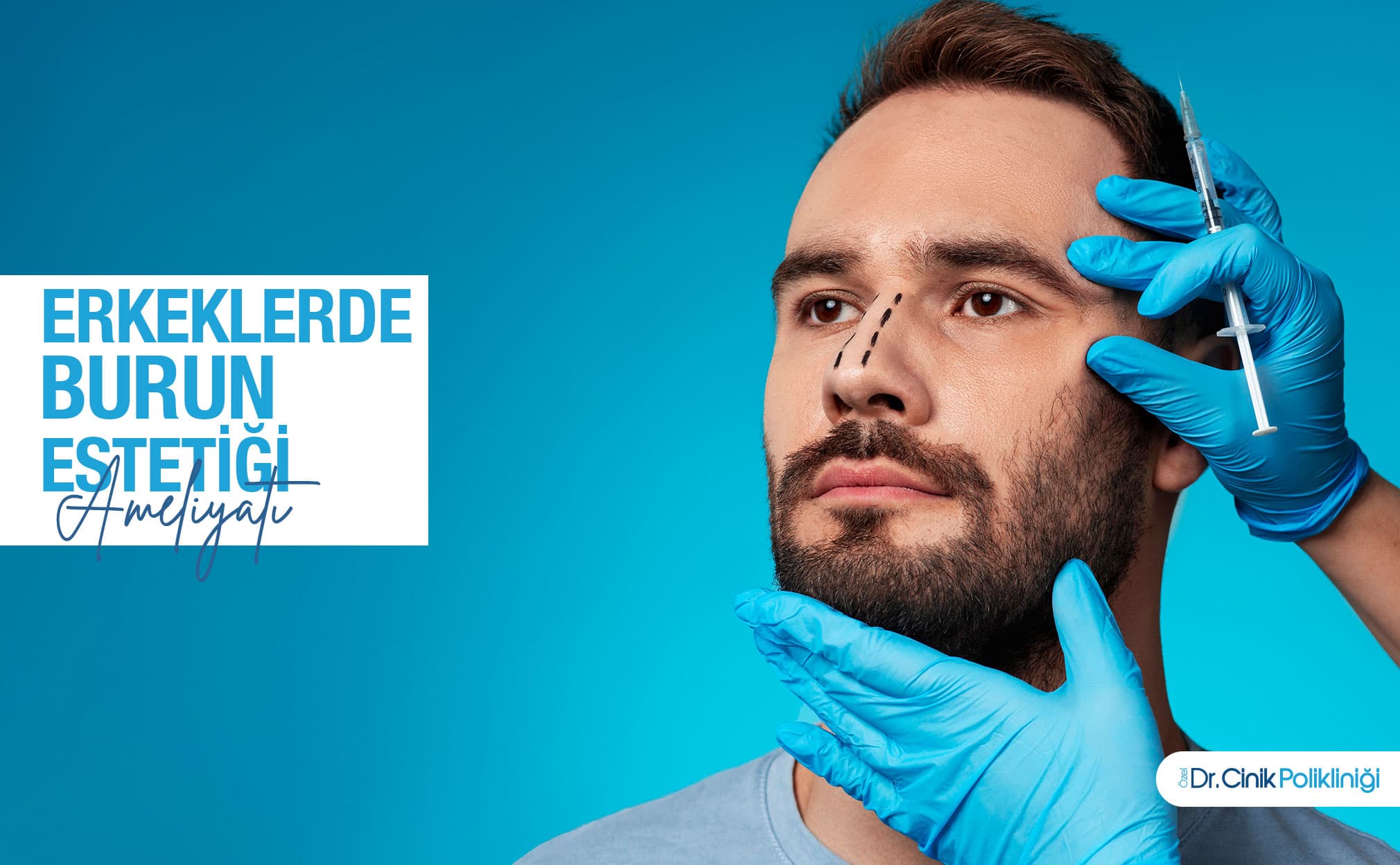
Rhinoplasty is the surgical reshaping of the nose's structure, size, and function. In men, this procedure improves aesthetic appearance and resolves respiratory issues.
Rhinoplasty is a surgical intervention that alters the nasal structure located at the center of the face. This procedure addresses not only cosmetic concerns but also functional issues (Rohrich and Griffin, 2020). Male patients have shown increased interest in this surgery in recent years. Data from the American Society of Plastic Surgeons (ASPS) indicates that the demand for aesthetic surgery among men has increased by 29% over the last decade.
Male nasal anatomy shows distinct differences compared to females. Men have thicker skin. The cartilage structure is stronger. The nasal dorsum is wider. These characteristics directly affect surgical planning. The procedure also includes functions such as correcting septal deviation, relieving nasal obstruction, and repairing post-traumatic deformities (Shapiro, 2024).
The aim of the study is to establish the scientific foundations of male rhinoplasty. It explains anatomical differences. It compares surgical techniques. It details the recovery process. It analyzes patient satisfaction.
In men, the nasal skin is thicker, the cartilage structure is stronger, and the nasal bridge is wider. The nasofrontal angle is flatter. The rotation of the nasal tip is less.
The male nasal structure contains a dense bony-cartilaginous framework. This structure creates a strong support system. Skin thickness directly affects the results of rhinoplasty. Lee and colleagues (2011) measured nasal skin thickness using computed tomography. The study found an average thickness of 3.3 mm in the nasion area, 2.4 mm in the rhinion, 2.9 mm at the nasal tip, and 2.3 mm in the columella. Thick skin can mask underlying cartilage changes. This complicates surgical planning.
In men, the skin at the nasal tip is particularly thick. Sebaceous gland activity is increased. Collagen fibers are denser. This structure causes postoperative swelling to last longer.
Springer and colleagues (2008) revealed inter-gender differences in nasal shape. In men, the position of the nasion is higher both vertically and horizontally. The nasal profile is straight or slightly concave. In women, the nasion is lower and more posterior. The profile is more concave.
In men, the ideal nasolabial angle is between 90-95 degrees. In women, this angle is considered to be 95-110 degrees. The angle difference determines the angle the nasal tip makes with the lips. In men, the nasal tip is less elevated. This maintains a masculine appearance.
Table 1: Comparison of Nasal Anatomy Between Genders
Anatomical Feature | Feature in Males | Feature in Females | Surgical Impact |
Skin Thickness | 2.9 mm (thicker at the tip) | Thinner | Swelling lasts longer in males |
Cartilage Structure | Strong, dense | Thinner, delicate | Strong support needed in males |
Nasal Frontal Angle | Flatter (90-95°) | More open (95-110°) | Rotation difference |
Nasal Width | Wider dorsum | Narrower | Osteotomy techniques vary |
Bone Structure | Thicker, longer | Thinner, shorter | Breaking techniques are different |
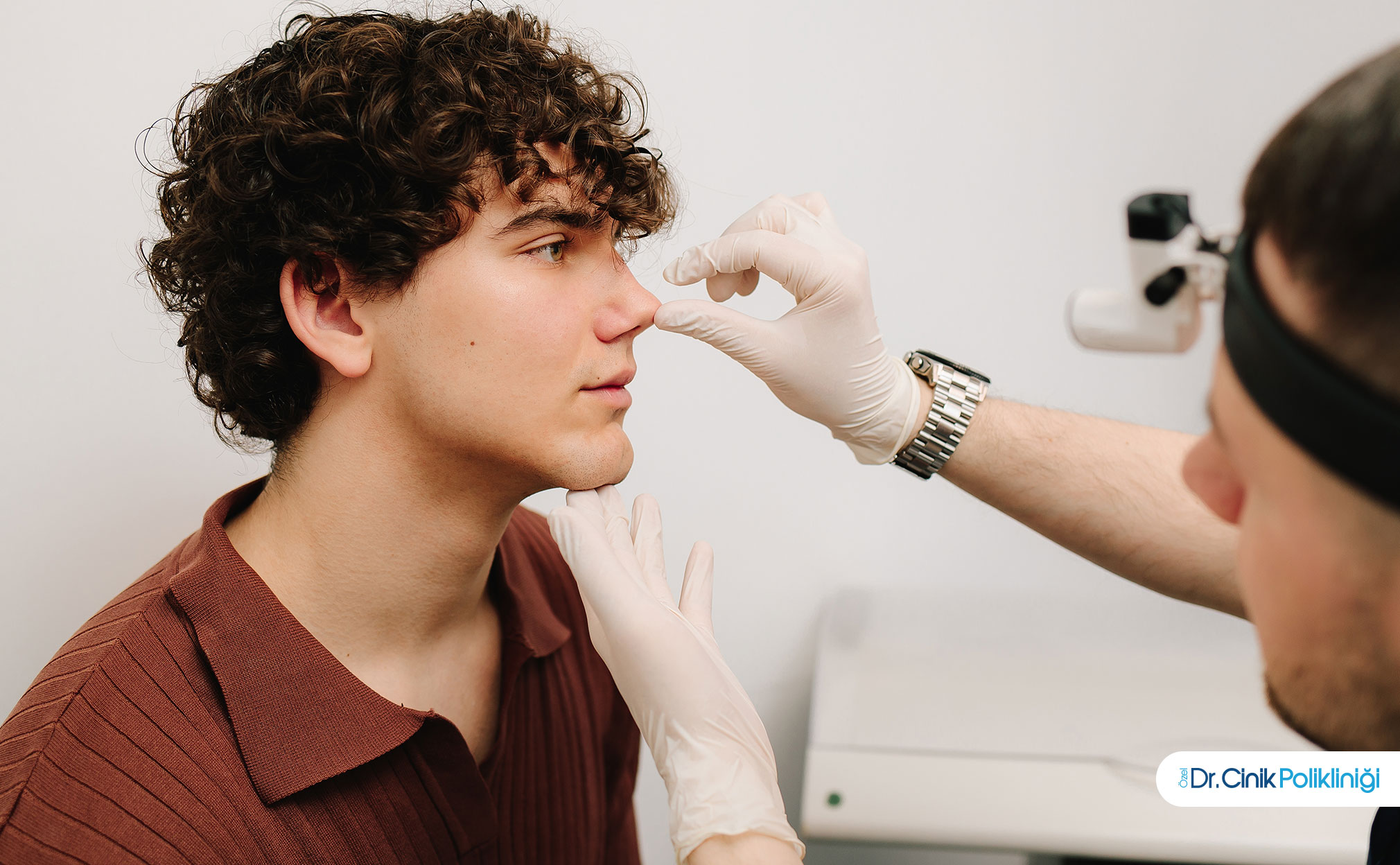
Male rhinoplasty creates facial proportion, maintains a masculine appearance, corrects respiratory functions, and repairs post-traumatic deformities.
The primary aim in male rhinoplasty is to preserve a natural appearance. Excessive reduction or over-elevation of the nasal tip can lead to undesirable feminine results (Chahin, 2024). Surgeons perform facial analysis. One-third ratios are calculated. The nose-to-face harmony is evaluated.
Masculine aesthetic principles include: a straight nasal dorsal profile, a strong nasal root (radix), minimal nasal tip rotation, and a symmetrical nasal pyramid. The nose is located in the center of the face. It should be proportional. A natural appearance is critical.
Correcting septal deviation is the primary goal. The septum is the cartilage and bony structure that divides the nose into two. Its curvature makes breathing difficult. Goldfarb and colleagues (2024) investigated the use of septal extension graft (SEG). The study involved 34 patients with nasal obstruction. A 71.5% improvement in breathing scores was observed.
Functional rhinoplasty can be combined with aesthetic surgery. This is referred to as "septorhinoplasty." Both appearance and breathing can be corrected in a single session. Post-traumatic deformities are also repaired. Sports injuries are common in men. Fractured bones are corrected. Cartilage support is reestablished.
Open rhinoplasty, closed rhinoplasty, ultrasonic (piezo) rhinoplasty, and non-surgical filler techniques are used. Each method has its advantages and limitations.
Open rhinoplasty makes a small incision at the nasal tip (transcolumellar incision). The surgeon directly views the nasal skeleton. It provides a wide field of vision. It is ideal for complex deformities. It may be preferred in men due to thick skin and strong cartilage.
Its disadvantages include minimal scar risk. The scar is usually at an invisible level. The open technique also provides advantages in revision surgeries. Previous surgical scars are visible. It becomes easier to deal with scar tissue.
Closed rhinoplasty is performed entirely from inside the nose. It leaves no external scars. Surgical visibility is limited. It is suitable for simple procedures. It is effective for experienced surgeons. It is used when minimal correction is needed in men.
The piezo technique shapes bone with ultrasonic vibrations. Schaaf and colleagues (2016) compared this method with traditional instruments. The study included 84 patients. In the piezo group, swelling and bruising (ecchymosis) were significantly reduced. The patients' satisfaction scores at 6 months were higher.
Piezo refines the bone cutting process. It does not damage soft tissue. Bleeding is reduced. Healing is accelerated. It is ideal for men with thick bone structure. Tissue trauma is minimal.
Hyaluronic acid fillers provide a temporary solution. They carry no surgical risk. Results last 12-18 months. They have limited indications. They are suitable for minor corrections. A slight dorsal correction or asymmetry can be addressed in men. Since it is not permanent, it may require a transition to surgery.
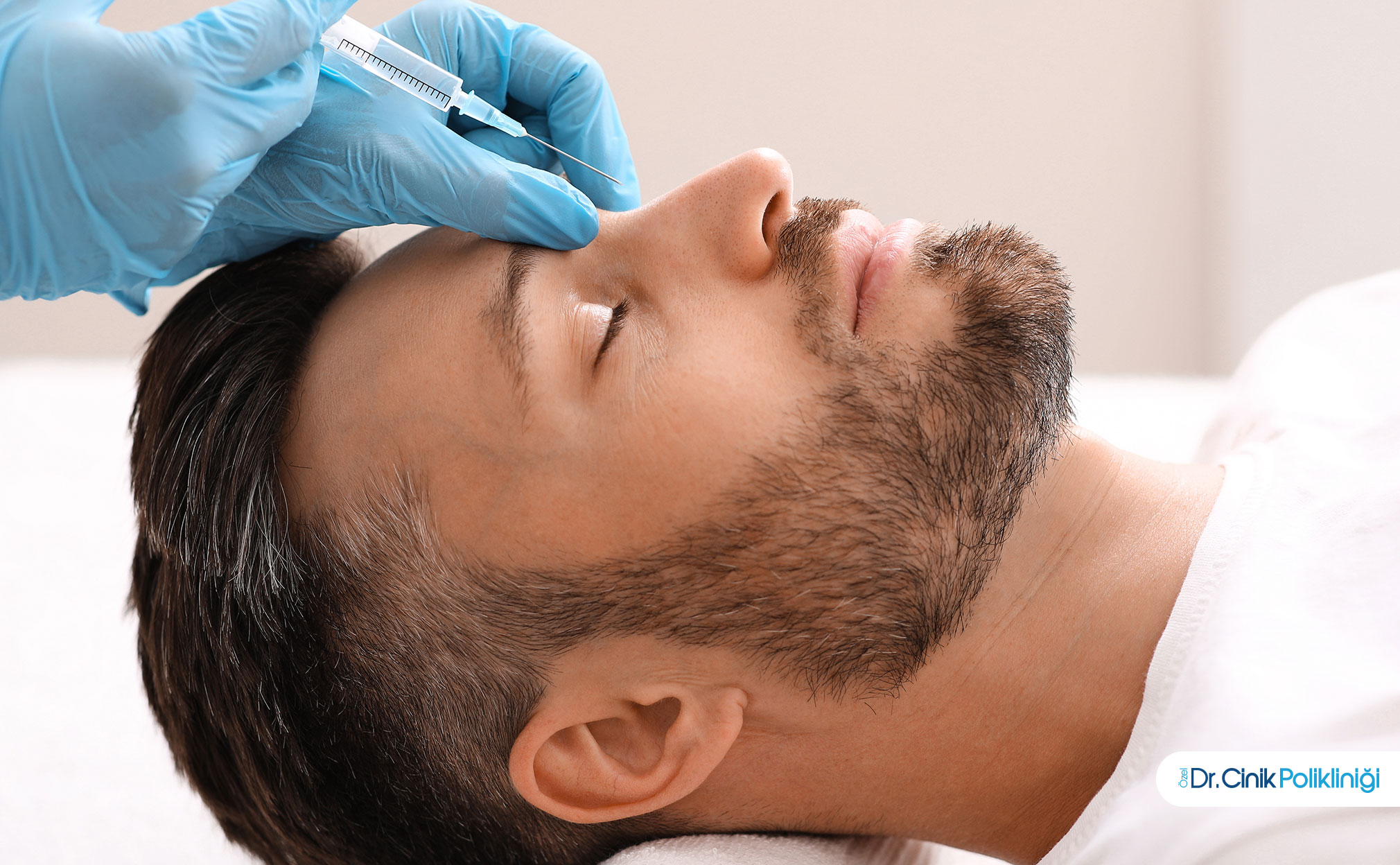
Facial analysis, patient-specific anatomical assessment, and masculine aesthetic principles are used together. Ethnic characteristics and personal expectations are taken into account.
Surgeons evaluate the one-third ratios of the face. The upper, middle, and lower face should be of equal length. The nose defines the midface. The forehead-brow-nose tip line is analyzed. The position of the nasion is measured. The nose projection (protrusion from the face) is calculated.
Digital planning and 3D simulation are used. This technology aligns patient expectations. Systems like Vectra 3D provide pre-operative outcome predictions.
The anatomy of each male patient is different. Ethnic characteristics are critical. European, Middle Eastern, Asian, or African descent patients have different bone structures. The surgical technique is adapted according to these characteristics.
Personal expectations are evaluated in detail. The patient explains what they want. The surgeon describes what is realistic. Psychological assessment is important. Rohrich and colleagues (2025) have shown that personality traits affect satisfaction. Calm individuals report higher satisfaction.
Excessive reduction is avoided. The nose must remain proportional to the face. A strong nasal bridge is preserved. The tip of the nose is not overly elevated. A nasolabial angle of 90-95 degrees is targeted. A natural appearance is essential. The ideal result is not a "surgically altered" look, but a "natural and smooth" appearance.
The process consists of a pre-operative assessment, a 1-2 hour operation under general anesthesia, and a post-operative follow-up period.
Physical examination is the first step. The surgeon examines the inside of the nose with an endoscope. The degree of septal deviation is determined. Cartilage strength is tested. Skin thickness is evaluated.
Photo analysis is standard. Five images are taken: front, right profile, left profile, basal (from below), and bird's eye view. Computer simulation is performed. Patient expectations are documented. Medical history is taken in detail. Blood-thinning medications are stopped.
General anesthesia is applied. The patient is completely asleep. The average duration of the operation is 1-2 hours. Complex revision cases may take up to 3 hours.
In the open technique, a columella incision is made. In the closed technique, an internal approach is used. Septoplasty is performed if necessary. The bony structure is shaped with piezo or classic osteotomies. Cartilage grafts (septal, ear, or rib) are used. The nasal tip is supported. The skin is closed. A splint is placed.
The first week is the most intense period for swelling and bruising. Cold compresses are recommended. The head is kept elevated. Antibiotics and pain relievers are given. The splint is removed after 5-7 days.
The healing process is monitored. A check-up is done in the first week. Follow-ups are planned at one month, three months, six months, and one year. In men, steroid injections may be applied early for thick skin (Reish, 2024).
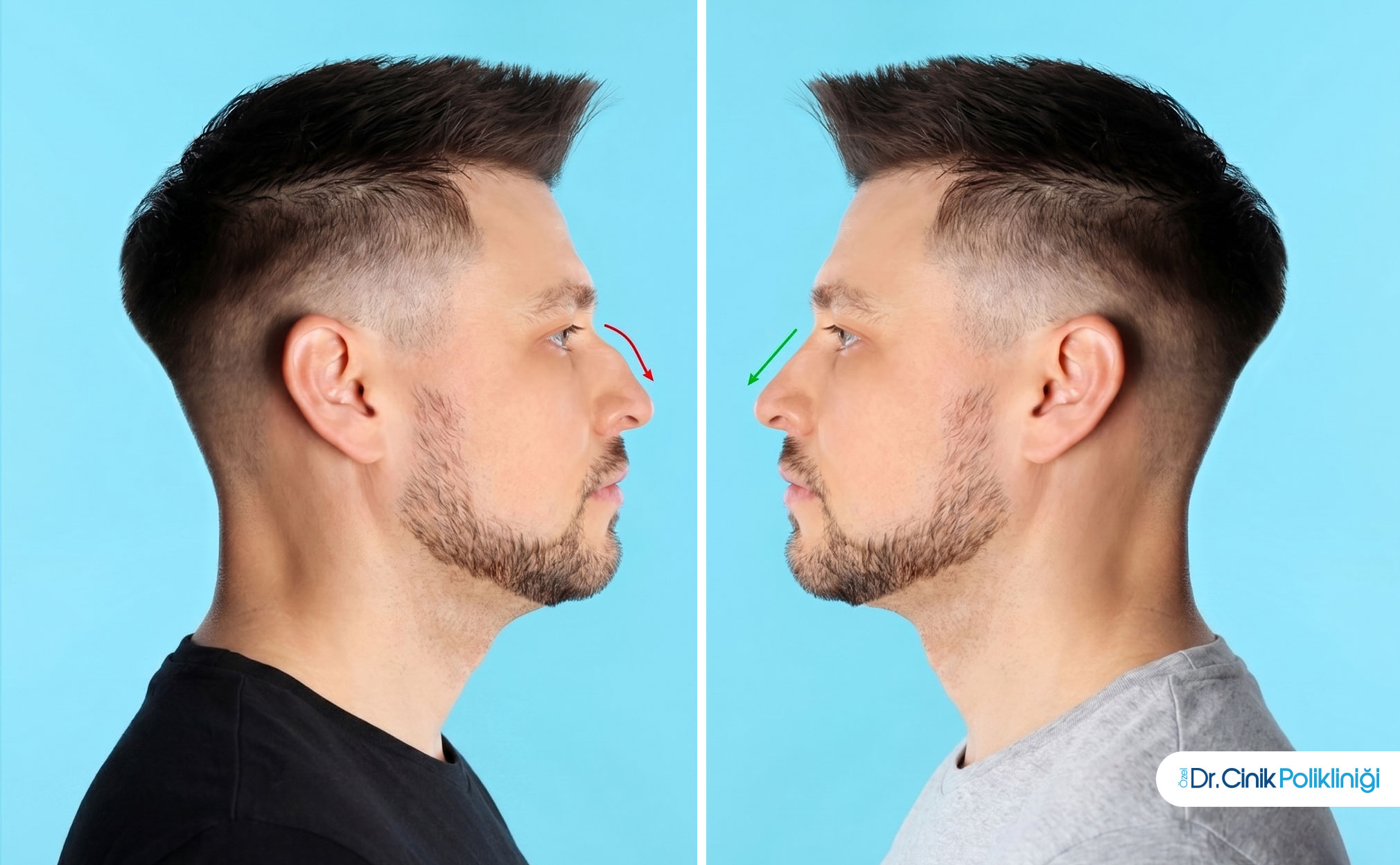
Return to social life occurs within 7-10 days. Final results take shape in 12-24 months. In men, healing takes longer due to thick skin.
Swelling peaks in the first 3 days. Bruising occurs around the eyes (periorbital ecchymosis). In men, bruising may appear darker due to skin thickness. Pain is moderate. Between days 4-7, bruising turns yellowish-green.
The return to social life takes 7-10 days. Returning to work is possible during this period. However, the nasal tip is still swollen. Makeup can be used to camouflage in men with beard growth.
80% of the swelling subsides within three months. The overall shape of the nose becomes more defined. However, in men, the final results may be delayed due to thick skin. Thinning continues between six to twelve months.
The final shape of the nose is formed in 12-24 months (Shapiro, 2024). The nasal tip, being the thickest area, takes the longest to shape. Collagen remodeling is completed. It fully settles into the underlying structure.
Infection, bleeding, failure to meet aesthetic expectations, and the need for revision are the main risks. The revision rate is between 5-15%.
The risk of infection is around 1-2%. Prophylactic antibiotics are used. Bleeding (hematoma) is rare. It is monitored under a splint. Granuloma formation is a rare complication.
Asymmetry may require correction. Nasal congestion may persist. Nasal tip drooping (ptosis) may be observed. Bone prominence (polly beak deformity) may occur.
Revision rhinoplasty rates vary. The literature reports between 5-15% (Dayan, 2021). In some series, this rate may rise to 10-20%. The need for revision may be higher in men compared to women. Schaaf and colleagues (2016) found that 76% of revision patients were female and 24% were male. However, due to the low referral rate in men, a relative risk assessment is necessary.
It provides significant improvement in facial aesthetics, increased self-confidence, improvement in respiratory functions, and achieves facial symmetry.
Balance in the face is an important gain. The nose is central. A straight nose balances the face. Increased self-confidence has been proven in psychological studies. Alshehri and colleagues (2024) showed that patient satisfaction increased by 59.49% after surgery.
Respiratory functions objectively improve. Improvement is observed in lung function tests. Exercise capacity increases. Snoring decreases. Sleep quality improves.
Anatomical structure, aesthetic ideals, technical approaches, and recovery times vary by gender. In men, the skin is thicker, and the target is more masculinized.
The experience of the surgeon is critical. Plastic surgery or otolaryngology expertise is essential. Institutional certification is important. Patient selection must be done carefully. Realistic expectations must be set.
The surgical technique should be adapted to the anatomy. Strong cartilage support is required for thick skin. Excessively aggressive resection (tissue removal) should be avoided. Graft use is rare.
Functional and aesthetic goals are addressed together. Hsiao and Lee (2024) demonstrated that collaboration between plastic surgeons and rhinologists yields better results. In the combined surgical group, functional scores were significantly higher (p=0.032).
Breathing is a priority. Aesthetic is a secondary goal. However, modern rhinoplasty combines both. Nasal surgery should not cause shortness of breath.
Nasal aesthetics in men require personalized planning. Anatomical differences determine the surgical approach. Natural and masculine results are the fundamental criteria for success.
Male rhinoplasty is based on scientific principles. Thick skin, strong cartilage, and masculine aesthetic principles guide the process. The choice of surgical technique is made according to anatomy. Functional results are as important as aesthetics.
Patient satisfaction is high. However, men have different expectations compared to women. Open communication is essential. Long-term follow-up is necessary. The final result becomes clear in 1-2 years.
Return to social life occurs in 7-10 days. Complete healing takes 12-24 months. Due to thick skin in men, the duration of swelling may be prolonged.
Male patients are curious about the postoperative process. A splint (nose brace) is applied in the first week. During this time, swelling and bruising occur. The splint is removed in 5-7 days. Return to work happens in 7-10 days. However, swelling at the tip of the nose continues. Most swelling subsides in three months. Due to the thick skin structure in men, the final shape develops over 12-24 months. This process requires patience.
Yes, a natural appearance is possible. When the correct surgical technique and masculine aesthetic principles are applied, there will be no surgical scar.
Naturalness is the most important goal of male rhinoplasty. A well-planned surgery gives a "not changed nose" but a "well-proportioned and handsome" appearance. The tip of the nose is not excessively lifted. The bridge of the nose is kept straight. Facial proportions are preserved. Experienced surgeons maintain this balance. After surgery, no one should say "had aesthetic surgery." They should say "looks very good."
Yes, rhinoplasty is a permanent procedure. The bone and cartilage structure takes a permanent shape. However, slight changes may occur with aging.
The results of rhinoplasty are permanent for a lifetime. When the bone is broken or reshaped, it remains in the new position. Cartilage grafts settle in. However, the nose is affected by the aging process. The shape of the nose is preserved for years. However, the skin may lose its elasticity. The tip of the nose may slightly droop. These changes are minimal. A second surgery is not required.
It is suitable for limited situations. In minor corrections,hyaluronic acid fillers offer a temporary solution. It is not permanent and is insufficient for major changes.
Fillers are used carefully in men. A slight contour correction can be made on the bridge of the nose. Asymmetry can be corrected. However, the nose cannot be enlarged. Since it is not permanent, it should be repeated every 12-18 months. It is not a surgical alternative. It is a temporary solution. There is a risk of trauma in men who engage in sports. The filler may disperse.
Alshehri, Hamed A., et al. "Assessment of Postoperative Satisfaction in Patients Following Rhinoplasty: A Cross-sectional Study." Cureus, vol. 16, no. 5, 2024, e59592.
Chahin, Fadi, and Richard Reish. "Understanding the Key Difference in Rhinoplasty for Men and Women." American Society of Plastic Surgeons, 18 Apr. 2024.
Dayan, Steven H., et al. "Revision Rhinoplasty: A 12-year Experience of 83 Patients." Plastic and Reconstructive Surgery – Global Open, vol. 9, no. 10, 2021, e3798.
Goldfarb, Jared M., et al. "Patient-Reported Outcome Measures Including Nasal Breathing Improvement After Functional Rhinoplasty Using Endonasal Septal Extension Grafting." Facial Plastic Surgery & Aesthetic Medicine, vol. 26, no. 4, 2024, pp. 446-450.
Hsiao, Yung-Chang, and Tzu-Jen Lee. "Comparison on Functional and Esthetic Outcomes Between Single and Combined Surgery to Crooked Nose Deformities." Journal of Plastic, Reconstructive & Aesthetic Surgery, vol. 88, 2025, pp. 32-40.
Jang, Yong Jun, et al. "Aesthetic and Functional Outcomes of Combined Use of Extended Spreader Graft and Septal Extension Graft in Septorhinoplasty." PMC, vol. 15, no. 5, 2023, e12028620.
Lee, Joo Hyun, et al. "Nasal Skin Thickness Measured Using Computed Tomography and Its Effect on Tip Surgery Outcomes." Otolaryngology–Head and Neck Surgery, vol. 144, no. 4, 2011, pp. 522-527.
Reish, Richard. "Understanding the Key Difference in Rhinoplasty for Men and Women." ASPS Expert Insights, 2024.
Rohrich, Rod J., et al. "Rhinoplasty and the 'Big Five' Model: The Impact of Patients' Personality Traits on Post-surgical Satisfaction Outcomes." Aesthetic Plastic Surgery, vol. 49, 2025, pp. 1-8.
Schaaf, Heidrun, et al. "Piezotome Rhinoplasty Reduces Postsurgical Morbidity and Enhances Patient Satisfaction: A Multidisciplinary Clinical Study." Journal of Cranio-Maxillofacial Surgery, vol. 44, no. 9, 2016, pp. 1163-1169.
Shapiro, Daniel. "Rhinoplasty for Men vs. Women: Key Differences." Shapiro Aesthetic Plastic Surgery, 6 Apr. 2024.
Springer, Ingo N., et al. "Gender and Nasal Shape: Measures for Rhinoplasty." Plastic and Reconstructive Surgery, vol. 121, no. 2, 2008, pp. 629-636.