Yükleniyor…
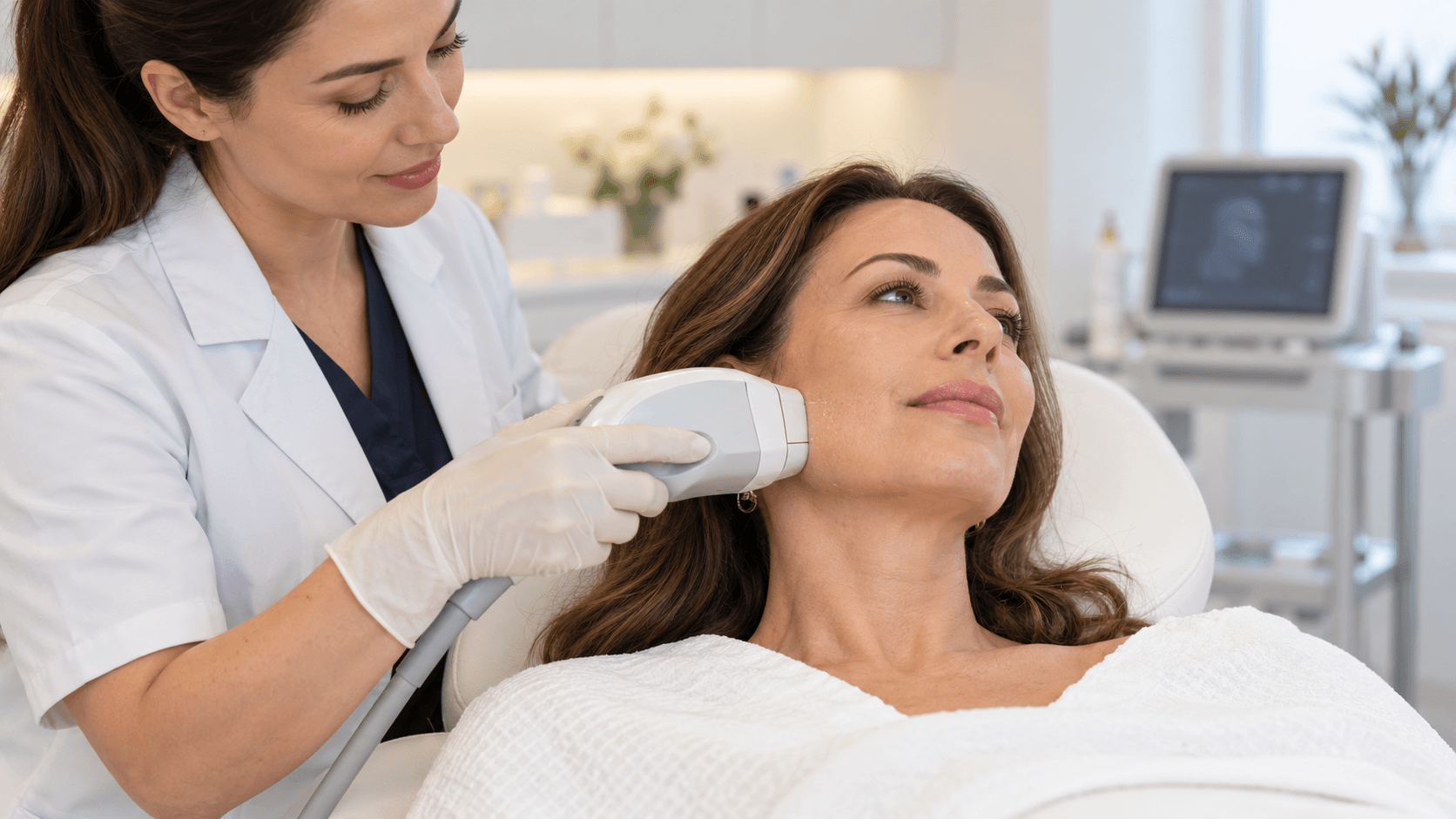
Ulthera delivers micro-focused ultrasound energy to the deep support tissues of the skin without surgical incisions. The controlled thermal points it creates in targeted layers initiate the body's natural healing response and support new collagen synthesis. The aim of the treatment is not to surgically cut and alter the tissue, but to activate the body's own renewal mechanisms by stimulating fibroblasts (Alam et al. 2010).
The most prominent signs of skin aging are associated with collagen loss. Therefore, the question "How does Ulthera support collagen production?" is one of the fundamental topics of interest for those researching the treatment. This article explains the working principle of Ulthera, the biological healing process, and how results develop over time within a scientific framework.
Collagen forms the structural skeleton of the skin and directly determines its durability, firmness, and elasticity. As the collagen network in the skin decreases, looseness, fine lines, and loss of elasticity occur (Ganceviciene et al. 2012).
Collagen, the most commonly found structural protein in the skin, forms a fiber network in the dermis layer. This network helps the skin remain tight and resilient. Collagen fibers also support elastin fibers, allowing the skin to stretch and return to its original shape.
Type of Collagen | Main Function in Skin | Relation to Age |
Type I | Provides durability and firmness | Amount significantly decreases |
Type III | Provides elasticity and support | Production decreases with age |
Type VII | Strengthens the dermal-epidermal connection | Decrease accelerates looseness |
As we age, both collagen production decreases and the organization of existing fibers deteriorates. This dual change directly affects the skin's firmness and texture (Varani et al. 2006).
In the initial stage of aging, fibroblasts begin to produce less collagen. In the second stage, existing collagen fibers break down and turn into an irregular structure. This breakdown also increases oxidative stress and accelerates the degradation process by elevating the activity of enzymes such as matrix metalloproteinase-1 (Fisher et al. 2009). As a result, the skin both thins and the support network weakens.
Ulthera directs micro-focused ultrasound energy to specific tissue layers beneath the skin's surface without touching it. The energy creates controlled thermal areas at targeted points, triggering a tissue repair response that stimulates new collagen formation (Shome et al. 2011).
Unlike classic surface treatments, Ulthera's energy can reach deeper layers. The system focuses the energy to the planned depth by informing the target layer. This precise focusing preserves surrounding tissues and creates a controlled effect only in the targeted area.
Ultrasound energy can reach different depths, creating a controlled thermal effect in the treatment area while protecting the skin surface and surrounding tissues (Fabi and Gold 2014).
The energy creates small thermal coagulation areas at the planned depth. These areas are positioned with millimeter precision, leaving intact tissue in between. This preserved intact tissue contributes to the rapid and orderly progression of the healing process. There are no cuts, stitches, or open wounds on the skin surface.
Controlled thermal effects activate the body's natural repair mechanism, reorganizing the old and damaged collagen structure and initiating new collagen synthesis (Alam et al. 2010).
Thermal stimulation activates fibroblasts. The activated fibroblasts first secrete enzymes that break down damaged collagen, then begin to produce new fibers. This two-phase process forms the basis of tissue remodeling.
Collagen production is not a one-time event. It is a biological process that continues over weeks and months. The early healing response and long-term tissue remodeling progress in different stages (Lee et al. 2011).
Immediately after treatment, repair signals occur at the tissue level. These signals attract inflammatory cells and fibroblasts to the area. In the initial weeks, these cells lay the foundation for repair and transition to intense collagen production in the following months.
Period | Biological Process | Observable Effect |
Week 1-4 | Initial repair signals | Slight tightening sensation |
Month 1-3 | New collagen synthesis | Gradual increase in firmness |
Month 3-6 | Collagen maturation | More pronounced appearance |
Fibroblasts are the main producer cells of connective tissue. Their activity increases after treatment, synthesizing new collagen and organizing these fibers in a regular structure (Varani et al. 2006).
Fibroblasts are cells that reside in the dermis layer. Their function is to produce collagen, elastin, and extracellular matrix. After controlled thermal stimulation, these cells proliferate and their production capacity increases. The new fibers they produce gradually form a regular network over time.
Neocollagenesis is a medical term that refers to the formation of new collagen. The controlled tissue stimulation of Ulthera initiates and supports this process (Shome et al. 2011).
The newly formed collagen fibers initially have a looser structure. Over months, these fibers strengthen, tighten, and integrate with the existing fiber network. This maturation process is the biological reason for the gradual emergence of results.
New collagen increases the firmness and elasticity of the skin. The results are not just a surface change; they reflect the biological remodeling beneath the skin (Werschler et al. 2016).
Clinical studies show that results develop gradually. Initial changes are felt in the weeks following treatment, while noticeable results typically emerge within two to three months (Lee et al. 2011).
Regular collagen fibers strengthen the structural integrity of the skin and delay the visible signs of aging due to loss of elasticity (Ganceviciene et al. 2012).
Elasticity is the skin's ability to stretch and return to its original shape. This ability depends on elastin fibers and the collagen network that supports them. A dense and organized collagen structure helps the skin appear both tighter and more resilient.
Newly formed collagen contributes to the appearance of tighter skin over time in relaxed tissues. Observable changes can occur in appropriate treatment areas such as the jawline, neck, and brow region.
Results vary from person to person. Age, skin quality, and degree of looseness are the main reasons for this variation. Therefore, expectations should be set realistically.

The ultimate effect of Ultherapy depends on biological healing and collagen remodeling. The slight changes that can be seen in the initial period are different from the long-term results. Noticeable results typically develop within a few months (Fabi and Gold 2014).
This delay is not a deficiency; it is a natural part of the process. While tissue is immediately repositioned in surgery, results from Ultherapy are produced by the body's own production power.
The formation of new collagen continues for weeks and months after treatment. The maturation and reorganization of fibers take time, so results should not be assessed too early (Lee et al. 2011).
The persistence of results depends on factors such as age, skin and connective tissue quality, degree of looseness, treated area, individual healing response, and the continuation of aging.
Factor | Effect Direction |
Young age | Stronger fibroblast response |
Good skin quality | More organized collagen structure |
Mild looseness | Clearer results |
Regular maintenance | Support for results |
Ulthera can provide support for individuals with mild to moderate skin looseness, addressing issues such as loss of jawline definition, mild double chin looseness, neck looseness, and brow drooping. However, it does not create the same level of anatomical change as surgical facelift (Alam et al. 2010).
Loss of tightness in facial skin, mild sagging, a more defined jawline appearance, and improvement in the appearance of some fine lines are expected (Werschler et al. 2016).
Improvement in mild to moderate looseness of neck skin and the appearance of fine lines in the décolleté area is targeted. Results vary according to anatomical features.
Energy is directed to the deeper support layers of the skin, with no cuts or surgical procedures performed on the surface. Micro-focused ultrasound is applied to the targeted tissues in a controlled manner (Fabi and Gold 2014).
No. Ulthera is a specific micro-focused ultrasound system. HIFU is a broader term that encompasses different devices and protocols. Imaging, energy application, treatment depth, and device characteristics vary by system.
Comparison Criteria | Ulthera | General HIFU Devices |
Imaging | Ability to monitor tissue | Varies by device |
Energy control | Millimetric focusing | Varies by system |
Depth options | Standardized layers | Device-dependent variation |
Ulthera does not surgically eliminate advanced skin laxity or pronounced tissue sagging. It does not solely correct significant facial volume loss. Pigmentation, acne scars, or excessive fat accumulation are not primary treatment goals.
Skin laxity and tissue quality vary from person to person. Treatment depth and energy application should be planned according to individual anatomy. Expectations should be realistically set, and the procedure should be performed by an experienced healthcare professional.
Collagen remodeling is an ongoing process after treatment. The durability of results is influenced by individual aging, skin characteristics, and lifestyle. Results develop over time after a single application, and maintenance or retreatment depends on personal assessment (Lee et al. 2011).
Yes. Micro-focused ultrasound initiates the tissue repair response through controlled thermal stimulation and supports new collagen formation (Shome et al. 2011).
The biological repair response begins immediately after treatment, and new collagen formation continues for weeks to months (Alam et al. 2010).
Visible changes gradually appear, and significant results typically develop within two to three months (Lee et al. 2011).
No. Collagen production does not completely halt the aging process, and the durability of results depends on personal factors.
No. It can provide a certain level of skin tightening, but it is not equivalent to surgical tissue changes.
No. Age, skin quality, level of looseness, anatomical structure, and individual healing response affect the results.
Ulthera is a specific micro-focused ultrasound system, while HIFU is a broader term that encompasses different devices.
Sun protection, regular skin care maintenance, maintaining healthy lifestyle habits, and following personal care recommendations based on expert evaluation are necessary.
Alam, Murad, et al. "Ultrasound tightening of facial and neck skin: a rater-blinded prospective cohort study." Journal of the American Academy of , vol. 62, no. 6, 2010, pp. 1047-1056.
Fabi, Sabrina G., and Michael H. Gold. "Microfocused ultrasound with visualization for noninvasive treatment of skin laxity." Seminars in Cutaneous Medicine and Surgery, vol. 33, no. 4, 2014, pp. 185-190.
Fisher, Gary J., et al. "Collagen fragmentation promotes oxidative stress and elevates matrix metalloproteinase-1 in fibroblasts in aged human skin." The American Journal of Pathology, vol. 174, no. 1, 2009, pp. 101-114.
Ganceviciene, Ruta, et al. "Skin anti-aging strategies." Dermato-Endocrinology, vol. 4, no. 3, 2012, pp. 308-319.
Lee, H. J., et al. "Evaluation of clinical efficacy and safety of Ultherapy in Korean patients: a retrospective review." Journal of Cosmetic and Laser Therapy, vol. 13, no. 5, 2011, pp. 226-233.
Shome, Devraj, et al. "Pilot study of a novel microfocused ultrasound modality for producing non-invasive facial lifting and skin tightening." Journal of Cosmetic , vol. 10, no. 4, 2011, pp. 294-302.
Varani, James, et al. "Decreased collagen production in chronologically aged skin." The American Journal of Pathology, vol. 168, no. 6, 2006, pp. 1861-1868.
Werschler, W. Philip, et al. "Ultrasound tightening of facial and neck skin: a rater-blinded prospective cohort study." Journal of Cosmetic , vol. 15, no. 3, 2016, pp. 340-345.