Yükleniyor…
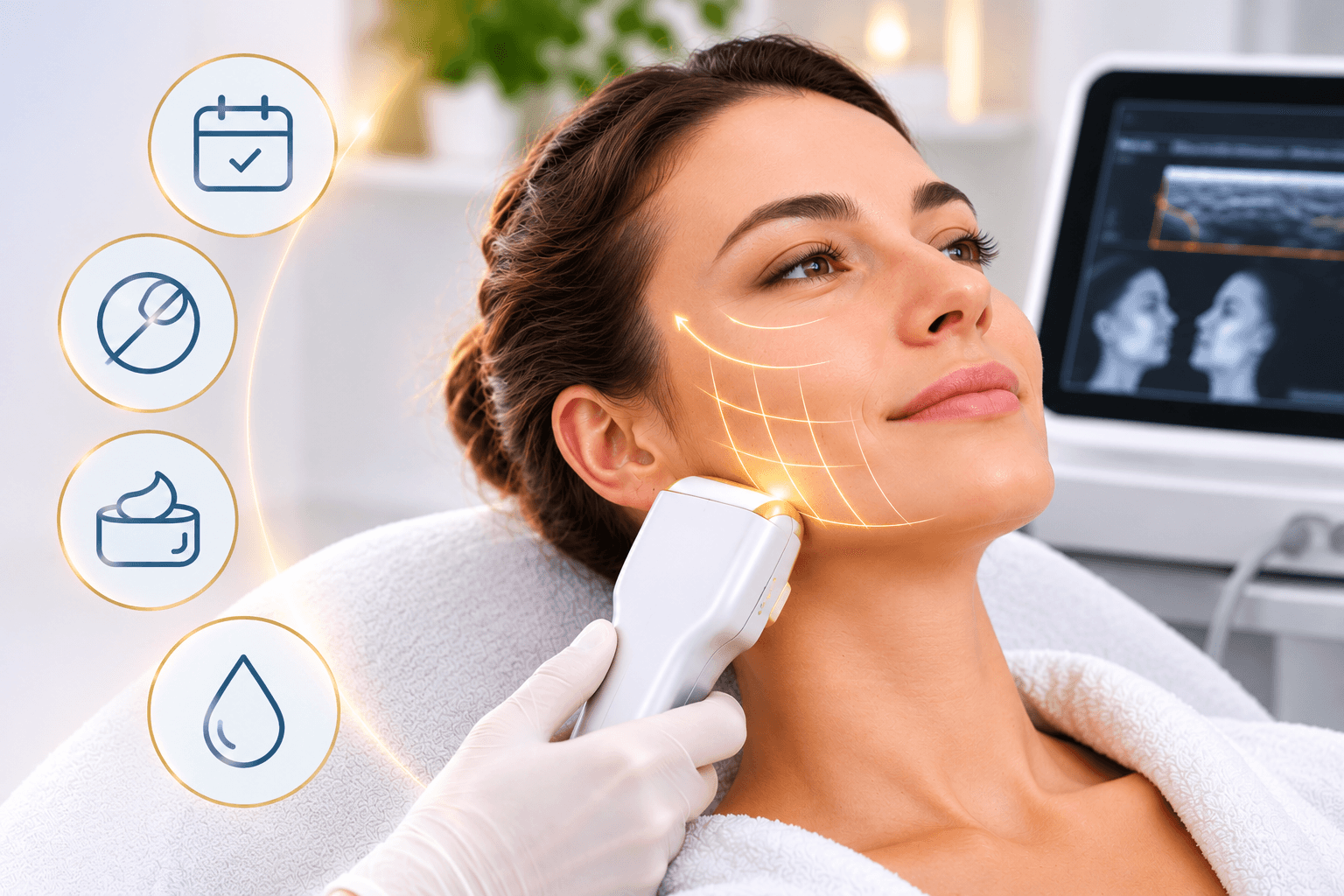
Ulthera is a non-surgical skin tightening and facelift method that stimulates collagen production by heating subcutaneous tissues with focused ultrasound energy. Proper preparation directly affects the safety of the procedure and the quality of the results. This guide explains all the steps you need to know before the procedure, from skin assessment and medication use to skincare and pain management, based on scientific evidence.
Focused ultrasound technology delivers energy through the skin’s surface to specific layers of deeper tissue. This mechanism tightens the skin without the need for surgical incisions. However, the success of the treatment does not depend solely on the device. The skin being healthy on the day of the procedure, proper management of medications, and the preparation of a personalized treatment plan are the key factors determining the quality of the results. Therefore, the preparation process is just as important as the treatment itself.
Before the procedure, the specialist physician evaluates your skin elasticity, degree of sagging, collagen loss, and skin thickness through a clinical examination.
Skin assessment is the first and most critical stage of treatment planning. The doctor examines the tissue structure in different areas of your face. Relaxation along the jawline, drooping around the eyebrows, and sagging in the neck and décolleté areas are assessed separately. This evaluation determines which areas will receive energy and at what depth.
The degree of collagen loss is central to this assessment. With age, the collagen fibers in the skin’s supportive layer decrease and become disorganized. Ulthera is designed to stimulate the regeneration of these fibers (White et al., 2007). Mild to moderate skin laxity represents the patient profile that responds best to this treatment. For individuals with advanced sagging, surgical options may be more appropriate, and your doctor will guide you honestly in this regard.
Skin thickness and the amount of facial fat tissue also shape the treatment plan. In thin skin, energy is directed toward more superficial layers. In thicker areas with a higher concentration of fatty tissue, deeper transducers are preferred. Nerve pathways and bony prominences in the facial anatomy define the boundaries of the safe areas where energy can be applied. This anatomical mapping both enhances effectiveness and reduces the risk of side effects.
During the consultation, you should fully disclose any previous aesthetic procedures, chronic conditions, medications you use, allergies, and expectations.
Providing complete information is the foundation of a safe procedure. Previous fillers, Botox, thread treatments, or surgical interventions can alter the current condition of the subcutaneous tissues. Knowing this history enables the doctor to plan the energy application accurately. For example, a different approach may be required in areas where fillers have been applied recently.
Your chronic conditions and any medications you take regularly should also be discussed. Diabetes, connective tissue disorders, or conditions that affect wound healing may alter the treatment plan. Skin sensitivity, a history of eczema, or reactions to aesthetic procedures you have experienced in the past can help the practitioner assess potential risks.
The final part of the consultation focuses on managing expectations. Ulthera results appear gradually over two to three months as collagen regeneration takes place (Fabi, 2015). Understanding this timeline helps establish realistic expectations. Your doctor will also identify the areas to be treated and present a personalized treatment plan. This plan provides the framework for all the steps you will follow during the preparation process.
You should inform your doctor about blood-thinning medications and supplements that increase the risk of bleeding, but you should never stop taking any medication without your doctor’s approval.
Some medications and supplements can increase the risk of bruising or bleeding during and after the procedure. Therefore, you should clearly disclose every product you use during the consultation. The table below summarizes these products and the general approach.
Product group | Examples | Possible effect | General approach |
Blood-thinning medications | Aspirin, warfarin, clopidogrel | Risk of bruising and bleeding | Adjusted only at the doctor’s discretion |
Pain relievers | Ibuprofen, naproxen | May increase the tendency to bleed | Use before the procedure should be reported to the doctor |
Herbal supplements | Ginkgo, garlic, fish oil | Blood-thinning effect | To be disclosed during the consultation |
Vitamins | High-dose vitamin E | May increase the risk of bleeding | Use will be evaluated |
Regular prescription medications | Blood pressure and thyroid medications | Overall health planning | Continue without discontinuation and inform your doctor |
As shown in the table, the most important rule is never to stop medications arbitrarily. If a person taking blood thinners due to heart disease stops their medication on their own initiative, it may lead to serious health problems. The correct approach is for your aesthetic doctor to coordinate with the physician who prescribed the medication. This collaboration protects both your safety and the quality of your treatment.

You should not use products containing active ingredients such as retinol, retinoids, glycolic acid, and salicylic acid for the period specified by your doctor before the procedure.
Active skincare ingredients can thin the skin barrier and increase sensitivity. During Ulthera, sensitized skin may respond with more intense discomfort and prolonged redness. Therefore, you should simplify your skincare routine before the procedure.
Products containing retinol and retinoids thin the outermost layer of the skin by accelerating cell renewal. Exfoliants such as glycolic acid and salicylic acid have a similar effect. Peeling treatments and intensive skin-renewal care are also considered within the same category. The time at which these products should be discontinued varies according to your skin type and the product concentration, so the instructions provided by your practitioner are essential.
During this period, the products you should choose are gentle cleansers and moisturizers that protect the skin barrier. A healthy skin barrier helps ensure that your skin is in optimal condition on the day of the procedure. This preparation should be considered together with the next topic, sun protection, as both aim to preserve the integrity of the skin.
Yes, you should avoid intense sun exposure, tanning beds, and artificial tanning products during the period before the procedure.
The sun’s ultraviolet rays cause inflammation and sensitivity in the skin. Sunburned or irritated skin may respond unpredictably to focused ultrasound energy. Tanning beds carry the same risk because they also provide intense ultraviolet exposure. Your doctor will examine your skin on the day of the procedure and postpone the treatment if burns or irritation are detected.
Using a broad-spectrum sunscreen is recommended during this period. Products that protect against both UVA and UVB rays help keep the skin healthy before the procedure. Physical protection methods, such as wearing a hat and staying in the shade, also complement this strategy. Protected skin provides both a more comfortable treatment experience and a faster recovery process.
Since Ulthera is not a surgical procedure, it does not require extensive preparation; however, you are generally advised to stop using active skincare products a few days before the treatment.
One of the greatest advantages of non-surgical procedures is that they do not interrupt daily life. Hospitalization, general anesthesia, or extended time off are not required. Preparation mainly consists of adjusting your skincare routine and protecting your skin from the sun.
Many clinics recommend discontinuing exfoliating and bleaching products approximately three days before the procedure. The period for avoiding sun exposure and tanning beds is generally planned as one to two weeks. These timeframes are not fixed rules. Your skin type, the strength of the products you use, and your personalized treatment plan determine the preparation schedule. The dates provided by your doctor always take priority over general recommendations.
On the day of the procedure, you should come to the clinic with clean skin free of makeup, sunscreen, and cosmetic residue, and choose comfortable clothing.
The purpose of preparation on the day of the procedure is to ensure that the treatment area is in ideal condition for energy transmission. Makeup and cosmetic residue interfere with the ultrasound gel’s contact with the skin. Therefore, you are advised to wash your face with a gentle cleanser in the morning and go to the clinic without applying any products. If the neck and décolletage will be treated, these areas must also be clean.
Before the procedure, your doctor will perform a final check for wounds, irritation, or active infection on the skin. If any of these conditions are present, the procedure will be postponed. Comfortable clothing with a wide neckline makes it easier to access the treatment area. Arriving at your appointment on time and following all the instructions provided by the clinic will help ensure that the process proceeds smoothly.
For most patients, a topical anesthetic cream is sufficient; sedation is not routinely required, and the anesthesia plan is determined according to the individual’s pain threshold.
Focused ultrasound energy creates thermal points in deep tissues that reach 60 to 70 degrees Celsius. This heat initiates collagen denaturation and new collagen production (Laubach et al., 2008). During the procedure, you may feel a prickling sensation, warmth, or deep tenderness. This sensation indicates that the energy has reached the correct layer and passes within seconds.
The pain management plan is decided together during the consultation. For patients with a low pain threshold or in sensitive areas such as the jawline, topical anesthetic creams are applied. When deemed necessary, a nerve block under local anesthesia may be considered. Sedation is not a routine practice and is considered only in special circumstances. The comparison below summarizes the options.
Anesthesia method | When used | Post-procedure effect |
Topical cream | Standard approach, most patients | The effect wears off quickly |
Nerve block | Sensitive areas, low pain threshold | Regional numbness may last several hours |
Sedation | Only in special circumstances | An escort may be required after the procedure |
Without anesthesia | Mild treatments | Immediate return to daily life |
You must inform your doctor about any active skin infection, open wound, facial implant, nervous system disorder, pregnancy, or breastfeeding.
Active infections and inflammatory skin conditions in the treatment area require the procedure to be postponed. Applying energy to infected tissue increases the risk of complications. Open wounds and unhealed incisions are evaluated in the same way.
Implants and metal materials in the facial area may alter the behavior of ultrasound energy. Previous facial surgeries may affect scar formation in the tissues and the location of the nerves. Disorders associated with the nervous system are also taken into consideration when planning treatment. Since there is insufficient safety data for individuals who are pregnant or breastfeeding, treatment is generally not recommended during these periods. Your suitability for treatment can only be determined after an individual assessment and clinical examination.
Your doctor selects the appropriate ultrasound transducer based on your skin thickness and anatomical structure, while the number of lines is determined according to the size of the treatment area and your individual needs.
Each area is evaluated separately during treatment planning. The face, double chin, jawline, brow, neck, and décolleté have different tissue depths. The Ulthera system includes transducers that work at depths of 1.5 mm, 3 mm, and 4.5 mm. While superficial transducers are used in areas with thin skin, the 4.5 mm transducer reaches the SMAS layer, which is also targeted during surgical facelift procedures (MacGregor and Tanzi, 2013).
Targeting the SMAS layer is the anatomical basis of the treatment’s tightening effect. Ultrasound imaging is used to reach this layer safely. Imaging allows your doctor to visualize the underlying structures in real time. The number of lines is not a standard figure. The size of the area, skin structure, and desired outcome determine this number. Personalized planning ensures both the accurate use of energy and optimal results.
Ulthera Prime enables more personalized and precise treatment planning by visualizing the underlying tissues in real time.
Ulthera Prime combines microfocused ultrasound energy with the DeepSEE imaging system. This system displays the subcutaneous layers on a screen during the procedure. Your doctor can directly visualize the targeted depth and the surrounding anatomical structures. This visual control allows the energy to be directed away from sensitive structures such as blood vessels and nerves.
Compared with standard devices, imaging-guided planning offers two main advantages. First, the anatomical precision of energy delivery is increased. Second, since each patient’s tissue depth differs, treatment depths can be personalized according to actual measurements. This technological infrastructure directly supports the anatomical assessment during the preparation phase and reduces the risk of side effects (Lee et al., 2012).
The most common side effects are temporary redness, swelling, tenderness, and bruising, while serious complications are rare when the procedure is performed using the correct technique by an experienced practitioner.
Informed consent is an integral part of safe treatment. Clinical studies show that microfocused ultrasound generally has a favorable safety profile (Fabi, 2015). Nevertheless, some temporary effects should be expected.
Side effects can be classified according to their frequency as follows:
Frequency | Side effect | Duration |
Common | Redness, mild swelling, tenderness | A few hours to a few days |
Less common | Bruising, numbness, tingling | A few days to a few weeks |
Rare | Burns, loss of fatty tissue, contour irregularities | Variable; medical follow-up required |
As this table shows, serious complications are rare and are most often associated with incorrect energy settings or inaccurate anatomical assessment. An experienced practitioner minimizes these risks through the correct selection of treatment handpieces and the use of imaging guidance. Discussing your individual risk factors with your doctor before the procedure completes this safety framework.
The procedure involves cleansing the skin, marking the treatment areas, applying ultrasound gel, and delivering energy under imaging guidance; its duration varies depending on the treatment area.
If you have completed the preparation stage correctly, the process on the day of the procedure proceeds in a highly organized manner. First, the treatment area is cleansed and the treatment zones are marked on the skin. Ultrasound gel is then applied to the skin. This gel ensures continuous delivery of energy from the skin surface.
Your doctor delivers ultrasound pulses focused at the appropriate depths under imaging guidance. A full-face treatment generally takes 60 to 90 minutes, while treatments targeting a single area are shorter. You can return to your daily activities immediately after the procedure. Mild redness or tenderness may initially occur, but these effects resolve quickly. The primary tightening effect becomes more noticeable over the following months as collagen remodeling is completed (Alam et al., 2010).
Below, you can find the most frequently asked questions about the pre-treatment period, along with brief answers.
Can makeup be worn before Ulthera?
Your skin must be completely clean on the day of the procedure. Since makeup and cosmetic residue can interfere with the ultrasound gel’s contact, you are advised to arrive without makeup.
Should retinol use be discontinued before Ulthera?
Yes, retinol may increase skin sensitivity. The discontinuation period varies depending on your skin type and the product’s concentration, so your doctor will determine the appropriate course of action.
Should blood-thinning medications be stopped before Ulthera?
No, do not stop taking any medication without your doctor’s approval. If adjustments are necessary, the decision will be made jointly by your aesthetic doctor and the physician who prescribed the medication.
Is it inadvisable to eat or drink water before Ulthera?
For routine procedures without sedation, fasting is not specifically required. If sedation is planned, follow the clinic’s instructions.
Can Ulthera be performed if Botox or fillers have been administered beforehand?
Yes, but inform your doctor of the date of the previous injections, the product used, and the treatment area. The appropriate interval between the two procedures will be determined through an individual assessment.
Is shaving or facial cleansing necessary before Ulthera?
Avoid aggressive procedures that may irritate the skin. It is sufficient for the treatment area to be clean and free of irritation.
Do I need to take time off work before Ulthera?
No, extended preparation or time off work is generally not required. Most patients return to their normal activities on the same day after the procedure.
Alam, Murad, et al. "Ultrasound Tightening of Facial and Neck Skin: A Rater-Blinded Prospective Cohort Study." Journal of the American Academy of , vol. 62, no. 2, 2010, pp. 262-269.
Fabi, Sabrina Guillen. "Noninvasive Skin Tightening: Focus on New Ultrasound Techniques." Clinical, Cosmetic and Investigational , vol. 8, 2015, pp. 47-52.
Laubach, Hans-Joachim, et al. "Intense Focused Ultrasound: Evaluation of a New Treatment Modality for Precise Microcoagulation within the Skin." Surgery, vol. 34, no. 5, 2008, pp. 727-734.
Lee, Ho Sup, et al. "Multiple Pass Ultrasound Tightening of Skin Laxity of the Lower Face and Neck." Surgery, vol. 38, no. 1, 2012, pp. 20-27.
MacGregor, Jennifer L. and Elizabeth L. Tanzi. "Microfocused Ultrasound for Skin Tightening." Seminars in Cutaneous Medicine and Surgery, vol. 32, no. 1, 2013, pp. 18-25.
White, W. Matthew, et al. "Selective Creation of Thermal Injury Zones in the Superficial Musculoaponeurotic System Using Intense Ultrasound Therapy: A New Target for Noninvasive Facial Rejuvenation." Archives of Facial Plastic Surgery, vol. 9, no. 1, 2007, pp. 22-29.