Yükleniyor…

French thread lift does not have one specific starting age that applies to everyone. When making a decision, skin elasticity, changes in the facial oval, the degree of sagging, and overall health are more important than chronological age. A French thread lift is a non-surgical facial rejuvenation method that lifts facial tissues upward using specialized threads, whereas a surgical facelift is a comprehensive operation in which excess tissue is removed. The two procedures are not the same and may not always address the same concerns.
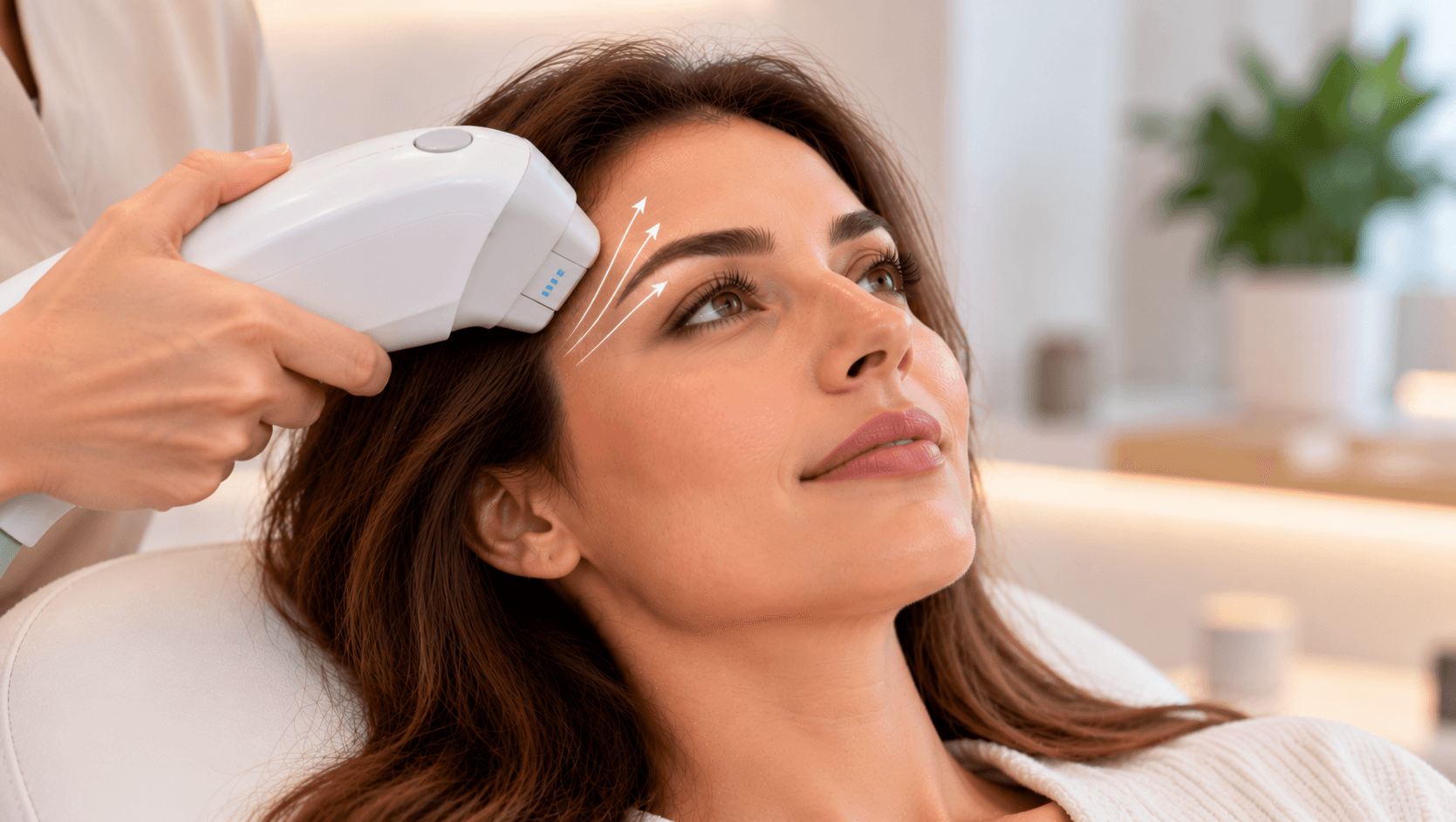
A French thread lift is a non-surgical facial rejuvenation method designed to lift facial tissues upward with the help of specialized threads. It targets concerns such as loss of definition in the facial oval, mild sagging, and loss of contour along the jawline.
The method is based on supporting facial tissues with dissolvable threads placed beneath the skin. The threads lift tissue in the lower cheek area and give the facial oval a more gathered appearance. However, the procedure does not completely transform skin quality on its own. Fine lines, pigmentation, and skin texture are separate areas that require evaluation. Results may likewise vary according to the individual’s facial anatomy. Thread lifting alone may not be sufficient for a thin face with volume loss.
At this point, an important distinction must be made: a French thread lift is not the same as a surgical facelift. A surgical facelift involves removing excess skin and repositioning facial muscle tissue. A French thread lift, on the other hand, suspends the existing tissues upward. This difference directly affects which method is appropriate for a particular age range and degree of sagging.
The method is generally considered for adults experiencing early- or moderate-stage facial sagging. However, being in one’s 30s, 40s, or 50s is not, by itself, sufficient to determine suitability.
Suitability is determined by evaluating three main variables together. The first is the degree of skin laxity. The second is the condition of the facial tissues and the cheeks’ resistance to gravity. The third is the individual’s expectations. A person in their 30s with pronounced structural sagging may be a more suitable candidate than someone in their 50s with mild laxity. Therefore, presenting a specific age range as an absolute rule is not scientifically accurate. Suitability must always be determined through an examination by a specialist.
Age group | Typical findings | Suitability of a French thread lift |
In your 20s | Significant sagging is rare | Not necessary for most people |
In your 30s | Mild laxity, early changes in the jawline | Appropriate in selected cases |
In your 40s and 50s | Moderate sagging, loss of contour | May be appropriate; limitations should be explained |
Older age | Possibility of significant excess skin | Likely to be insufficient |
Significant facial sagging is rare in this age group. Therefore, the procedure is not necessary for most people.
Genetic characteristics, facial anatomy, and certain structural changes that may appear at an early age can affect the assessment. For example, early contour support may be considered for people who have naturally sagging cheeks or a weak jawline. However, this is an exception. Social media filters or unrealistic beauty expectations alone should not constitute a reason for undergoing the procedure. In younger individuals, more suitable, less invasive options are evaluated first instead of unnecessary interventions. Facial aging progresses naturally, and every intervention performed at an early age may limit future options.
Scientific evaluations show that thread-lifting methods have their strongest effect on mild sagging (Grippaudo et al. 2017). Most faces in their 20s do not have this degree of sagging.

A French thread lift may be considered if there is mild laxity in the facial oval, early loss of jawline definition, or downward displacement of the cheek tissues.
Genetic predisposition, sun exposure, and weight fluctuations affect the rate at which the face ages. Sun damage reduces skin elasticity and accelerates sagging. The important point is that the procedure should not be evaluated solely as a way to prevent aging, but according to existing aesthetic needs. If sagging is not yet pronounced, an intervention may either be ineffective or fail to meet expectations.
Other non-surgical treatments are also options for mild concerns. Dermal fillers address volume loss, while skin rejuvenation methods target tissue quality. The French thread lift is not a rival to these methods, but may complement them in certain cases.
At these ages, skin laxity and changes in facial contours become more pronounced. The French thread lift can provide realistic results for mild to moderate sagging.
The method is limited in individuals with significant excess tissue or advanced sagging. Threads cannot remove excess skin. However, it is also incorrect to generalize that every patient necessarily needs more threads or a more comprehensive procedure as they age. The skin tissue of some people in their fifties is in better condition than that of someone who is thirty-five. Skin elasticity and tissue quality are more reliable indicators than chronological age.
Studies show that PDO threads provide clinically measurable improvement in facial rejuvenation, although their effectiveness decreases in cases of deep sagging (Suh et al. 2015).
Skin elasticity, facial anatomy, the degree of sagging, general health, and expectations are evaluated together.
Skin elasticity indicates the skin’s ability to recover and the extent of existing laxity. Facial anatomy encompasses the position of the cheeks, the jawline, and the distribution of facial tissues. The degree of sagging helps distinguish between mild, moderate, and advanced changes. General health includes medical history and medications used, which are considered in terms of procedural safety. Additional risks are assessed in individuals taking blood thinners. Expectations involve the patient’s understanding of the changes and limitations the procedure can provide.
Each of these five factors should be considered together. A patient with good skin elasticity but excessively high expectations may not be considered suitable for the method. Likewise, the procedure may be postponed for someone with mild sagging but a high-risk medical history.
Thread lifting may be insufficient for individuals with advanced excess skin and pronounced facial sagging.
Surgical facelift is considered in cases requiring more comprehensive tissue correction. There is an important concept here: skin quality, volume loss, and facial contour are different issues. If skin quality is impaired, skin rejuvenation methods are needed. If there is volume loss, volume-enhancing treatments take priority. Loss of contour and sagging, however, are addressed with a French thread lift or surgical facelift. These issues are too different to be resolved by a single procedure. A personal examination is essential when deciding between surgical and non-surgical options. General answers based on photographs or age ranges can be misleading.
A French thread lift provides a more limited tissue-lifting effect. A surgical facelift offers more comprehensive correction but requires a longer recovery period.
Criteria | French thread lift | Surgical facelift |
Procedure | Thread lifting, no surgical sutures | Skin and tissue correction, operating room |
Effect level | Mild to moderate sagging | Moderate to advanced sagging |
Recovery | Short, with a quick return to daily life | May take several weeks |
Longevity of results | Medium-term, varies by individual | Longer-lasting |
Risk profile | Lower | Involves anesthesia and surgical risks |
Systematic reviews show that the risks of thread-lift procedures are relatively limited, but that their results are more temporary compared with surgical facelifts (Grippaudo et al. 2017). No method is the best option for every patient. The right question is: which method can address which problem in this patient, and with what expectations?
Performing the procedure too early does not provide the expected benefit if there is insufficient aesthetic need. Advanced age alone does not make the procedure impossible.
The face’s natural aging process continues after the procedure. A French thread lift does not stop this process. The procedure may be considered at an advanced age if the skin and tissue characteristics are suitable. However, if excess skin is pronounced in older patients, the result may be limited. Basing the decision solely on the year of birth or a specific age limit cannot be scientifically justified. The aesthetic assessment focuses on the current condition of the face.
The face’s dynamic and static appearance, skin structure, degree of sagging, medical history, medications being used, expected results of the procedure, and possible complications are evaluated.
During the examination, the doctor assesses the face both at rest and while making facial expressions. This distinction reveals the actual degree of sagging. Previous aesthetic procedures are also recorded. The experience of the physician performing the procedure and ensuring that it is carried out under appropriate conditions are critical not only for the result but also for safety. Reviews examining the effectiveness of PDO threads in facial rejuvenation emphasize the impact of proper patient selection on outcomes (Sani et al. 2022). Poor patient selection is a more common cause of failure than technical errors.
Results vary depending on the technique used, the characteristics of the threads, the individual’s anatomy, and the aging process. A French thread lift is not a permanent method of stopping aging.
Threads undergo biological changes over time and, if they are dissolvable, disappear within the tissue. The tissues, meanwhile, continue to age naturally. Therefore, a personalized follow-up plan is required to maintain the result. In some individuals, the effect may last several years, while in others it may be shorter. Expecting permanent results from a method that does not stop aging is the most common cause of dissatisfaction.
The procedure’s suitability for your individual face, the feasibility of achieving the expected changes, alternative methods, risks, recovery process, and the practitioner’s experience must all be carefully evaluated.
These questions should be asked in the following form:
Is this procedure suitable for my current facial sagging?
Can the changes I expect be achieved with a French thread lift?
Is there a surgical or non-surgical alternative that may be more suitable for me?
What are the risks of the procedure, the recovery process, and the possibility that it may need to be repeated?
What information should I obtain about the experience of the physician performing the procedure and the follow-up plan?
A decision made before these questions are answered is not an informed aesthetic decision. Research supports the significant impact of patient education and expectation management on satisfaction (Lyu et al. 2019).
There is no definitive age limit for a French thread lift that applies to everyone. In addition to age, skin elasticity, the degree of sagging, facial anatomy, and expectations should be evaluated together.
The procedure is generally unnecessary for most people in their 20s. It may be considered in selected cases during the 30s. In the 40s and 50s, it may be effective for mild to moderate sagging. At an advanced age, skin and tissue characteristics determine the decision. After learning about the benefits and limitations of the procedure, suitable candidates should make the decision together with a specialist physician. This approach provides the most accurate answer to the question of how old one should be for a French thread lift: age has no meaning on its own unless it is considered together with the condition of the skin.
Grippaudo, Ferdinando, et al. "Thread-Lift Sutures: Still in the Lift? A Systematic Review of the Literature." Plastic and Reconstructive Surgery, 2017.
Lyu, Seon-Hwa, et al. "Promotional Effect of PDO Thread Embedding on Facial Skin Rejuvenation." Evidence-Based Complementary and Alternative Medicine, 2019.
Sani, Ariana, et al. "The Effect of PDO Thread Embedding on Facial Skin Rejuvenation: A Systematic Review." Aesthetic Surgery Journal Open Forum, 2022.
Suh, Dong Hye, et al. "Outcomes in Thread Lift for Facial Rejuvenation: A Study Performed with Happy Lift Revitalizing." Surgery, 2015.