Yükleniyor…

The neck is one of the areas that bears the earliest and most visible signs of aging. This article examines the effect of Ulthera treatment, based on microfocused focused ultrasound technology, on neck sagging, laxity, and lines in light of scientific evidence. It provides a systematic framework for addressing questions about the treatment’s mechanism of action, the aesthetic concerns it targets, the timeline for results to emerge, its safety profile, and who may be suitable candidates.
Yes, Ulthera is a clinically proven, non-surgical tightening option for mild to moderate skin laxity and sagging in the neck. The treatment has been approved by the U.S. Food and Drug Administration for lifting the skin in the neck and submental areas (Gliklich et al. 2007).
Ulthera offers an approach that delivers energy to structural layers beneath the skin without requiring a surgical incision. Because the neck is a continuation of the face, laxity in this area directly affects the definition of the jawline. For this reason, the neck is one of the most important treatment areas. The degree of effectiveness varies from person to person. Skin quality, age, and collagen-producing capacity are the primary factors that determine the outcome (Sasaki 2011).
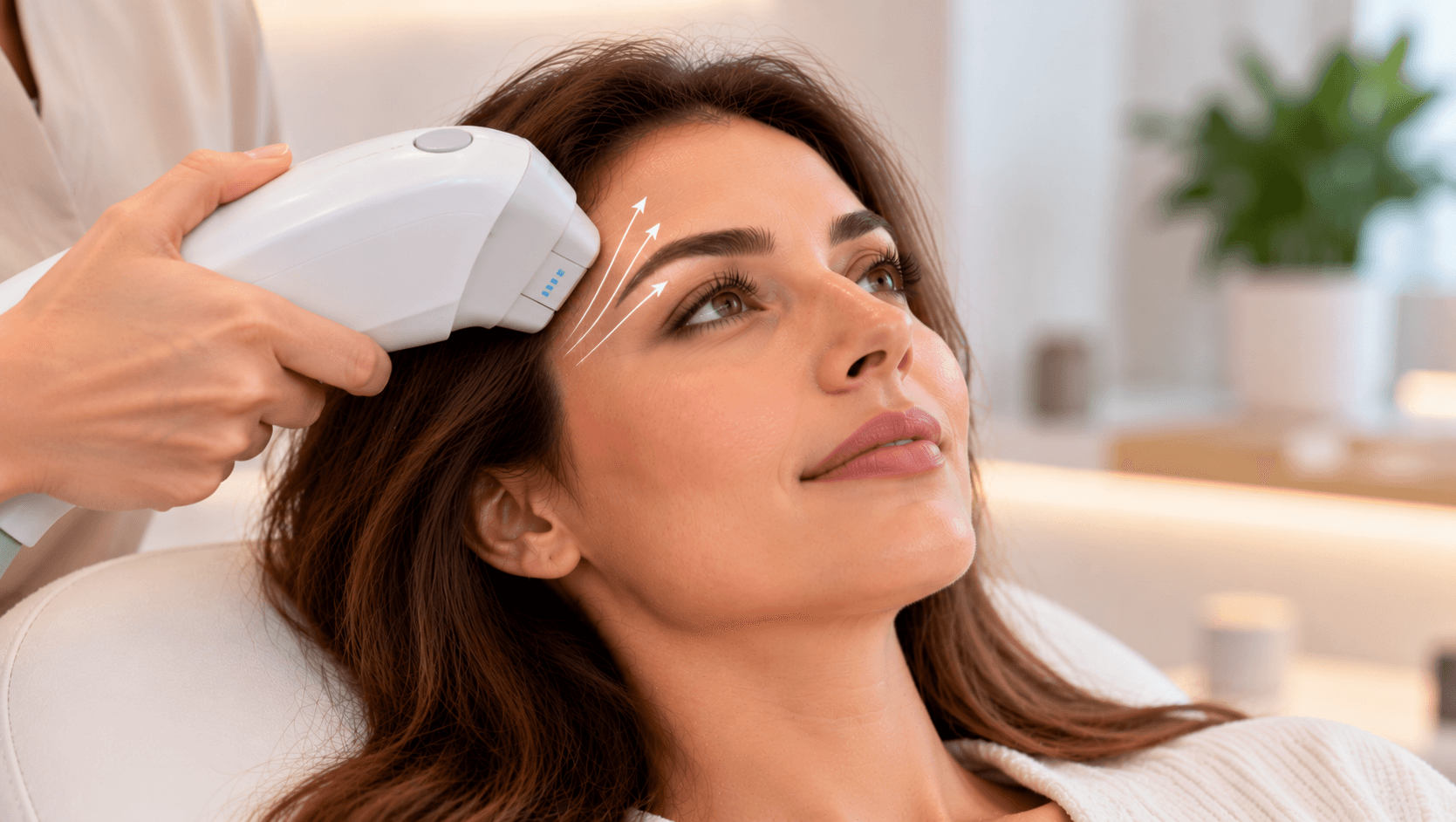
Ulthera delivers microfocused focused ultrasound energy to deep tissue layers without contacting the skin’s surface. The energy creates controlled areas of thermal coagulation at targeted points and triggers the body’s natural healing response (Laubach et al. 2008).
These thermal micro-injuries stimulate fibroblasts. Fibroblasts initiate the production of new collagen and elastin. Over time, the tissue remodels and the skin tightens. The key point is that the treatment does not alter the outer surface of the skin; instead, it focuses its energy on deeper structures, including the superficial muscular aponeurotic system (White et al. 2007). This feature is the primary scientific advantage that distinguishes the treatment from superficial procedures.
Ulthera primarily targets mild to moderate neck laxity, submental sagging, and the appearance commonly known as “turkey neck.” It may also provide some improvement in fine superficial lines.
Excess tissue beneath the chin reduces the definition of the jawline. As the skin tightens, this transition area may become more defined. With age, loss of skin thickness, reduced elasticity, and deepening wrinkles progress together. The treatment does not stop all of these changes, but it strengthens the collagen structure that supports tissue quality (Fabi 2015).
The visibility of the results varies depending on the individual’s age, degree of skin laxity, collagen-producing capacity, and anatomy. The treatment is characterized by natural, gradual improvement rather than a sudden and dramatic transformation (Oni et al. 2013).
Individual differences must always be taken into account when evaluating before-and-after clinical photographs. Even the same protocol may produce varying degrees of response in different skin types. Studies in the literature reporting 60-, 90-, and 180-day follow-up assessments of neck treatments show that results become more pronounced over time (Suh et al. 2011).
Initial changes are generally not visible immediately because the results depend on new collagen production, and this biological process takes time. Noticeable results typically develop over a period of 3 to 6 months.
During the first few weeks after the procedure, a mild feeling of tightness and improved skin texture may begin to appear. As the sixth month approaches, collagen remodeling matures and the tightening effect reaches its peak. The table below summarizes the typical process.
Period | Expected Change |
0 to 2 weeks | Mild feeling of tightening, with limited visible change |
1 to 3 months | Gradual tightening, with greater definition under the chin |
3 to 6 months | Peak results and most noticeable improvement |
After 6 months | Maintenance of results and, if necessary, maintenance planning |

The longevity of the results depends on individual factors, and sources report a duration of approximately 1 to 3 years (Sasaki 2011). The aging process does not stop, so new laxity may gradually develop over time.
Sun protection, a balanced diet, and healthy lifestyle habits may help prolong the results. For some individuals, the effect is satisfactory after a single session. For others, maintenance sessions may be scheduled at specific intervals to preserve the desired outcome. This decision is made following a skin assessment during a follow-up examination (Oni et al. 2013).
The most suitable candidates are adults with mild to moderate skin laxity who do not want surgical intervention. Individuals who are satisfied with natural, gradual results and have realistic expectations are the group most likely to benefit from the treatment (Fabi 2015).
Realistic expectations are the most critical determinant of treatment satisfaction. A patient expecting a surgical-level transformation from a non-surgical method will not be satisfied. Individuals with advanced skin laxity should evaluate different treatment options together with their physician.
No, Ulthera is not equivalent to surgical neck lift surgery. If there is a significant amount of loose skin and pronounced anatomical sagging, the treatment’s effect will remain limited (Alster and Tanzi 2009).
Two factors are evaluated separately when making a decision: skin quality and the degree of anatomical laxity. If skin quality is impaired but laxity is mild, the treatment may produce meaningful results. If excess tissue is pronounced, surgical options come to the forefront. For the right decision, surgical and non-surgical methods should be compared by a physician.
Ultrasound imaging enables the targeted tissue layers to be visualized in real time. This allows energy to be delivered in a controlled manner to the planned depth, reducing the risk of unnecessary effects on adjacent structures (Laubach et al. 2008).
Each person’s neck tissue differs in thickness and structure. Personalized treatment parameters are therefore essential. Imaging-assisted planning is fundamental to the safety and effectiveness of precise energy delivery (Oni et al. 2013).
The treatment follows a three-stage protocol: preliminary evaluation and skin analysis, marking the treatment area and personalized planning, followed by the application of ultrasound energy with a specialized applicator (Sasaki 2011).
During the procedure, sensations of warmth, pricking, or brief discomfort are normal. The session duration varies depending on the size of the treated area and is generally completed within 30 to 90 minutes. Since the planning stage directly determines the quality of the result, allocating sufficient time to this stage is critically important.
The procedure generally requires no significant downtime, and daily activities can be resumed the same day. This feature makes the treatment appealing to individuals with busy lifestyles (Suh et al. 2011).
Temporary redness, mild swelling, tissue sensitivity, tingling, or, rarely, bruising may occur. These reactions are generally short-lived and resolve on their own (Alster and Tanzi 2009).
Aging, reduced elasticity, and repetitive neck movements all contribute to the formation of these lines. Ulthera skin tightening may reduce their appearance through its skin-tightening effect, but it does not completely eliminate the lines (Fabi 2015).
Deep structural lines and superficial fine wrinkles do not form through the same mechanism. Therefore, they cannot be treated in the same way. Superficial wrinkles may sometimes respond better to complementary superficial treatments. Treatment planning should take this distinction into account.
There is an aesthetic transition zone between the neck and the jawline. Laxity beneath the chin directly reduces jawline definition. As the skin tightens, this transition may appear more defined and youthful (Suh et al. 2011).
For this reason, the neck and submental area should be evaluated together during treatment planning. A plan focused solely on the neck may overlook the harmony of the lower third of the face. A holistic approach is the key to natural-looking results (Oni et al. 2013).
Ulthera uses microfocused focused ultrasound and directs its energy into deeper layers with imaging guidance. While radiofrequency-based systems provide broader volumetric heating, laser systems primarily target the superficial layers of the skin (Fabi 2015).
Feature | Ulthera (Focused Ultrasound) | Radiofrequency | Laser |
Target depth | Deep, reaching subcutaneous tissues | Medium depth | Generally superficial |
Imaging guidance | Yes | Usually not available | No |
Need for surgical incision | None | None | None |
Onset of results | Gradual | Gradual | Gradual |
Ideal indication | Mild to moderate laxity | Mild laxity | Skin quality and wrinkles |
Treatment selection should be based not only on the technology but also on the degree of laxity and the desired outcome. The most appropriate choice is determined following an individual examination (Sasaki et al. 2011).
When performed within its approved indications, the treatment has a favorable safety profile. The side effects reported in clinical studies and during follow-up are generally temporary (Gliklich et al. 2007).
Reported reactions include redness, swelling, post-procedural pain, and, rarely, temporary nerve effects. The procedure must be performed by a licensed and experienced healthcare professional with imaging guidance, which is essential for both safety and the quality of results (Laubach et al. 2008).
A doctor’s evaluation reveals the degree of skin laxity, the anatomy of the neck, and the structure of the tissues to be treated. Without this information, an appropriate treatment plan cannot be created (Oni et al. 2013).
In addition, the patient’s aesthetic expectations must be aligned with the treatment goals. In some cases, Ulthera alone may not be sufficient. In others, a different approach or combination plan may provide better results. This decision can only be made through an in-person examination.
The scientific literature shows that clinical evidence supports the tightening and lifting results of microfocused focused ultrasound. Histological studies confirm increased collagen synthesis and tissue remodeling following treatment (Suh et al. 2011).
Initial validation studies demonstrated that the energy could create selective thermal damage zones in subcutaneous tissues, which was associated with clinical tightening (White et al. 2007). However, scientific records also clearly indicate that clinical outcomes vary among individuals and that the same degree of response should not be expected in every patient (Fabi 2015).
Yes, particularly for individuals with mild to moderate skin laxity, Ulthera is a meaningful non-surgical option. Its key advantages include collagen stimulation, natural and gradual results, minimal downtime, and a customizable treatment approach (Sasaki 2011).
However, results may be limited in cases of advanced sagging. A personal examination and professional assessment are essential to determine the most suitable candidates. The information presented in this article does not replace a physician’s advice; rather, it provides a scientific framework to support the decision-making process.
How many Ulthera sessions are required for the neck?
For most people, a single session is sufficient. Additional sessions may be planned depending on the skin structure (Oni et al. 2013).
Does Ulthera completely eliminate neck lines?
No. It can significantly reduce the appearance of lines, but it does not erase them completely (Fabi 2015).
Can Ulthera replace neck lift surgery?
No. Surgical methods are more effective for advanced sagging (Alster and Tanzi 2009).
When can I return to daily life after treatment?
Normal activities can generally be resumed on the same day (Suh et al. 2011).
Are the results permanent?
Results last for an extended period, but the effects may gradually diminish as the aging process continues (Sasaki 2011).
Alster, Tina S., and Elizabeth L. Tanzi. "Noninvasive Lifting of Arm, Thigh, and Knee Skin with Transcutaneous Intense Focused Ultrasound." Surgery, vol. 35, no. 11, 2009, pp. 1762-1765.
Fabi, Sabrina G. "Noninvasive Skin Tightening: Focus on New Ultrasound Techniques." Clinical, Cosmetic and Investigational , vol. 8, 2015, pp. 47-52.
Gliklich, Richard E., et al. "Clinical Pilot Study of Intense Ultrasound Therapy to Deep Dermal Facial Skin and Subcutaneous Tissues." Archives of Facial Plastic Surgery, vol. 9, no. 2, 2007, pp. 88-95.
Laubach, Hans-Joachim, et al. "Intense Focused Ultrasound: Evaluation of a New Treatment Modality for Precise Microcoagulation within the Skin." Surgery, vol. 34, no. 5, 2008, pp. 727-734.
Oni, Georgette, Yevgeny Rasko, and Jeffrey Kenkel. "Optimizing Patient Outcomes with Microfocused Ultrasound: Key Learning Points." Journal of Drugs in , vol. 12, no. 11, 2013, pp. 1294-1300.
Sasaki, Gordon H. "Microfocused Ultrasound for Noninvasive Skin Tightening: A Review." Aesthetic Surgery Journal, vol. 31, no. 6, 2011, pp. 622-628.
Suh, Dong Hye, et al. "Intense Focused Ultrasound Tightening in Asian Skin: Clinical and Pathologic Results." Surgery, vol. 37, no. 11, 2011, pp. 1595-1602.
White, W. Mark, et al. "Selective Creation of Thermal Injury Zones in the Superficial Musculoaponeurotic System Using Intense Ultrasound Therapy." Archives of Facial Plastic Surgery, vol. 9, no. 1, 2007, pp. 22-29.